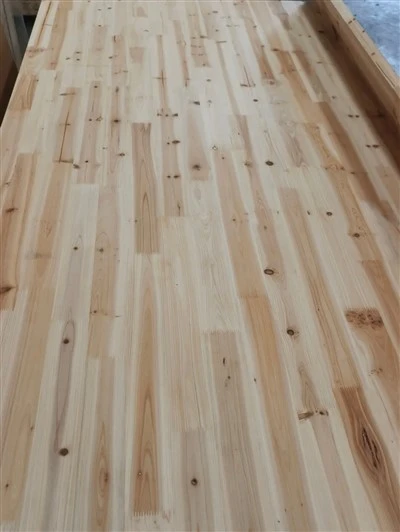
Finger Joint Wood Board technology is a longitudinal joining technique that involves processing the ends of wood into finger-shaped tenons and mortises, and then joining them together under pressure using an adhesive. This process improves wood utilization and provides good joint strength and stability.
I. Process Principle and Flow
This process uses specialized tools to mill the ends of the wood to form mutually matching finger-shaped structures. During processing, the angle, spacing, and depth of the tenons must be controlled to ensure full contact of the joint surfaces. A special adhesive is used during joining, and pressure is applied to ensure tight interlocking of the tenons and mortises. The adhesive layer thickness is generally controlled between 0.1–0.3 mm.
II. Main Technical Characteristics
1. High material utilization rate: Short pieces of wood can be joined to form usable boards, improving wood utilization efficiency, especially suitable for processing small-sized materials.
2. Good joint strength: The finger-shaped structure helps to distribute stress, and the bending and tensile strength of the joint can approach or reach the level of solid wood.
3. Improved dimensional stability: The finger joint structure reduces the exposed cross-section of the wood, helping to reduce deformation caused by changes in humidity.
4. High production efficiency: It can be adapted to automated production lines, enabling continuous processing and meeting the needs of large-scale production.
III. Applications and Standards
Finger Joint Wood Board technology is mainly used in furniture manufacturing, building wooden components, flooring substrates, and other fields. During production, indicators such as wood moisture content and bonding strength must be controlled. Using CNC machining and other methods can ensure joint accuracy and quality stability.
Overall, Finger Joint Wood Board technology offers advantages in improving wood utilization and ensuring joint performance, making it suitable for the manufacture of wood products that require high material performance and processing efficiency.