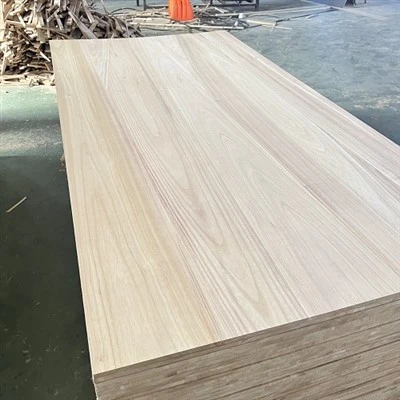


Lightweight yet High-Strength: Paulownia wood possesses a low density (approximately 0.26–0.35 g/cm³) and an average weight of 286 kg/m³; however, its grain is tough and resilient, making it resistant to breakage and cracking-ideal for crafting lightweight structural components.
Beautiful Grain:The grain is straight and fine-textured; when planed, it reveals a silky luster with a soft, natural, light yellowish-brown hue.
Excellent Workability: The wood is relatively soft, making it easy to carve, stain, and sand-perfect for handcrafted items, artisanal crafts, and the creation of intricate shapes.
Superior Physical Stability: It is highly resistant to deformation, warping, and cracking; featuring a low shrinkage coefficient, it offers excellent dimensional stability-making it suitable for components requiring high structural integrity, such as drawers, bed slats, and baseboards.
Corrosion and Pest Resistance: Its natural resistance to insects and decay surpasses that of most fast-growing timber species; it is moisture-resistant, acts as a moisture barrier, is impermeable to smoke, and is highly resistant to insect infestation.
Eco-friendly and Renewable: Characterized by rapid growth and abundant availability, it is a sustainably sourced timber that complies with E0/E1 environmental protection standards.
Insulation and Thermal Properties: It features a low thermal conductivity and strong electrical insulation properties, making it suitable for specialized applications such as architectural partitions and packaging crates.