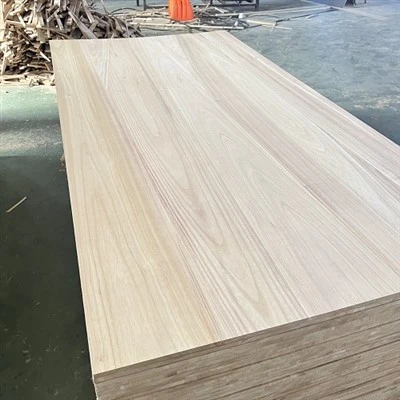
Paulownia veneer is a remarkable material known for its light - weight, strength, and aesthetic appeal. As a leading Paulownia veneer supplier, I often receive inquiries from clients regarding the maximum span that Paulownia veneer can support. This blog aims to comprehensively explore this topic, taking into account various factors that influence the span capacity of Paulownia veneer.
Understanding Paulownia Veneer
Paulownia is a fast - growing tree species, and its veneer is produced by slicing thin layers from the log. The resulting veneer has a smooth texture and a beautiful grain pattern. It is widely used in furniture manufacturing, interior decoration, and even in some specialized applications like surfboards. For instance, our 8mm Paulownia Wood Surfboard showcases the unique properties of Paulownia veneer in a real - world product.
Factors Affecting the Maximum Span
1. Thickness of the Veneer
The thickness of Paulownia veneer plays a crucial role in determining its maximum span. Generally, thicker veneers can support longer spans. A thicker veneer has more material to distribute the load, reducing the stress per unit area. For example, a 3 - mm thick Paulownia veneer will have a significantly lower maximum span compared to a 6 - mm thick one. In construction and furniture design, engineers and designers often select the appropriate veneer thickness based on the expected load and the required span.
2. Grade of the Veneer
The grade of Paulownia veneer is also an important factor. Higher - grade veneers are free from defects such as knots, cracks, and uneven grain. These defects can weaken the veneer and reduce its load - bearing capacity. A high - grade Paulownia veneer can support a longer span because it has a more consistent structure and better mechanical properties. Our Natural Paulownia Wood Board is made from high - grade Paulownia veneer, ensuring excellent performance in various applications.
3. Type of Load
The type of load that the Paulownia veneer will bear is another significant factor. There are two main types of loads: static and dynamic. Static loads are constant, such as the weight of a bookshelf on a Paulownia veneer shelf. Dynamic loads, on the other hand, are variable and can include impacts, vibrations, or moving loads. A veneer that can support a certain static load may not be able to handle the same load if it is dynamic. For example, a Paulownia veneer used in a dance floor will experience dynamic loads from the movement of dancers, and thus, a shorter span may be required to ensure its safety and durability.
4. Support Conditions
The way the Paulownia veneer is supported also affects its maximum span. There are different support configurations, such as simply supported, fixed - end, and cantilevered. In a simply supported configuration, the veneer is supported at two ends, and the load is distributed between these supports. A fixed - end support provides more restraint at the ends, allowing for a longer span. A cantilevered support, where the veneer is supported at one end only, has the most limited span capacity.
Calculating the Maximum Span
To calculate the maximum span of Paulownia veneer, engineers use mathematical formulas based on the principles of mechanics of materials. These formulas take into account the factors mentioned above, such as the thickness of the veneer, the type of load, and the support conditions. However, these calculations are often complex and require a good understanding of engineering principles.
In general, for a simply supported Paulownia veneer under a uniformly distributed static load, the maximum span (L) can be estimated using the following simplified formula:
[L = k\sqrt{\frac{t^{3}}{q}}]
where (t) is the thickness of the veneer, (q) is the load per unit area, and (k) is a constant that depends on the properties of the Paulownia wood, such as its modulus of elasticity and allowable stress.
It should be noted that this is a simplified formula, and in real - world applications, more detailed calculations and considerations are necessary.
Real - World Applications and Span Requirements
In furniture manufacturing, Paulownia veneer is commonly used for tabletops, shelves, and cabinet doors. For a typical bookshelf shelf made of 6 - mm thick Paulownia veneer with a simply supported configuration and a static load of books, the maximum span might be around 60 - 90 cm. This span ensures that the shelf will not sag or break under normal use.
In interior decoration, Paulownia veneer can be used for wall paneling. When used as wall panels, the span requirements are less critical because the panels are mainly used for aesthetic purposes and do not bear significant loads. However, proper installation and support are still necessary to ensure the panels remain in place.
In the case of our Paulownia Wood Boards, which are used in a variety of applications, the maximum span will vary depending on the specific use. For example, if the boards are used in a flooring application, the span will need to be carefully calculated to withstand the weight of people walking on it.
Conclusion
The maximum span that Paulownia veneer can support is influenced by multiple factors, including thickness, grade, type of load, and support conditions. As a Paulownia veneer supplier, we understand the importance of providing high - quality products that meet the specific requirements of our clients. Whether you are a furniture manufacturer, an interior designer, or involved in other industries, our team can help you select the right Paulownia veneer for your project and provide guidance on the appropriate span for your application.
If you are interested in purchasing Paulownia veneer for your project, we encourage you to contact us for a detailed discussion. We are committed to providing you with the best products and services to ensure the success of your project.
References
- "Mechanics of Materials" by Ferdinand P. Beer, E. Russell Johnston Jr., John T. DeWolf, and David F. Mazurek
- "Wood Handbook: Wood as an Engineering Material" by the U.S. Forest Products Laboratory